
As one of the mandatory certifications that cosmetics companies and manufacturing facilities in the ASEAN region must obtain, it comes as no surprise that cGMP ASEAN has a set of extremely strict and rigorous evaluation standards. So, what does this set of evaluation standards entail? Let’s find out in the following article.
Overview of cGMP ASEAN
cGMP ASEAN (Cosmetic Good Manufacturing Practice) is a certification established in 2003 through the collaboration of the 10 ASEAN member states and is currently managed by the ACC (ASEAN Cosmetic Committee). This certification primarily focuses on controlling the production process—from raw materials to finished products—to ensure product quality and protect consumer rights.
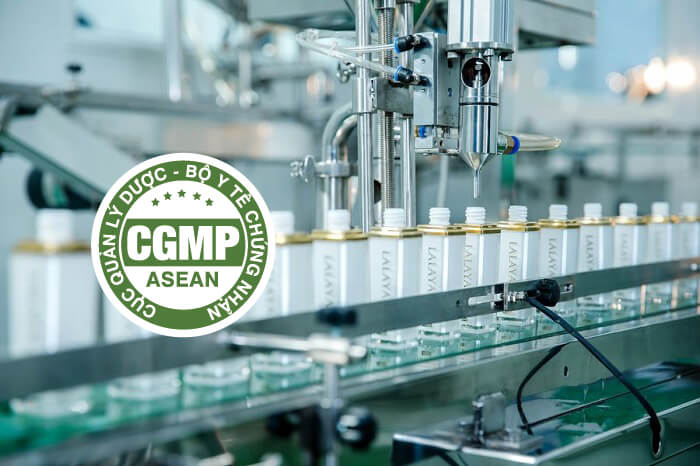
Why is cGMP ASEAN important?
Cosmetics are highly sought-after products worldwide, and the ASEAN region is no exception. This market began to boom in the late 1990s with the emergence of numerous cosmetic companies and manufacturers. However, due to this rapid growth, many substandard products managed to infiltrate the market, posing risks to consumer health. Furthermore, at that time, each ASEAN member country had its own set of standards, making it difficult to control and ensure the circulation of quality products.
To address this situation and protect consumers’ rights and health, ASEAN member states signed an agreement to adopt a single set of standards for all cosmetics businesses and manufacturers in the ASEAN region—the cGMP ASEAN. It can be said that cGMP ASEAN holds immense importance, as this certification not only facilitates the faster circulation of cosmetics within member countries while ensuring quality but also serves the mission of protecting consumers through its own strict standards.
And of course, cGMP ASEAN also brings many benefits to businesses and cosmetics manufacturers that successfully obtain the certification. Meeting the certification’s stringent standards demonstrates that the business or manufacturer has met the required standards at every stage and in every production process. This serves as a commitment to product quality from the business to consumers and partners, not only enhancing the company’s reputation but also helping to expand its partner network and market reach. Additionally, businesses can reduce production costs by minimizing errors, contamination, and other issues throughout the entire operational and production process.
Evaluation Standards
As mentioned, cGMP ASEAN focuses primarily on a company’s production processes, spanning from the initial input stage all the way to the finished product. This process includes the following 12 mandatory control aspects:
Quality Management System
The quality management system is the most important standard and serves as the foundation for the entire cGMP framework. Companies must establish mandatory testing procedures for each production batch, covering the entire process from raw material selection through to product shipment or disposal. Additionally, test results for each batch must be retained for at least one year after the product’s expiration date.
Personnel
All personnel at the manufacturing facility—including those in the warehouse, quality control, and sanitation departments—must undergo comprehensive training in GMP procedures. Specifically, certification requirements mandate that companies clearly separate production and quality control functions by appointing two distinct personnel to oversee each. This is intended to minimize conflicts of interest when deciding whether to release or reject products.
Facility
To prevent raw materials and finished products from passing through the same pathways—which could lead to cross-contamination—the facility must adhere to the one-way flow principle while clearly separating the spaces where production stages are carried out and controlling access by personnel.
Equipment
Equipment that comes into direct contact with the product must be made of chemically inert materials that do not react with cosmetic ingredients. In addition, this equipment must undergo regular maintenance at appropriate intervals.
Production Process
To ensure product quality stability and control the risk of incidents, each product must have a clear master formula record that includes a list of ingredients, mixing sequence, technical specifications, and inspection criteria for semi-finished products.
Quality Control
Products undergo specific testing criteria, including sensory testing (color, odor, viscosity), physicochemical testing (thermal stability, pH), and microbiological testing in accordance with the ASEAN Cosmetic Directive Annex VI. However, depending on the product line, companies may also need to supplement these three main criteria with results from other appropriate types of testing.
Documentation
To support product traceability, product records must be retained for at least 1 year after the expiration date or 2 years for products without an expiration date. Additionally, the documentation must provide complete details covering the entire lifecycle of each production batch.
Internal Audit
cGMP ASEAN requires companies to conduct an internal audit at least once a year, and the audit must be performed by someone who is not directly responsible for the area being inspected to ensure maximum transparency. The audit results will be compiled into an official report, including non-conformities along with a corrective action plan to be implemented within a specified timeframe.
Storage
The storage process is one of the most critical processes in the cosmetics industry. Therefore, the storage areas for raw materials and finished products must be properly controlled for temperature and humidity in accordance with established criteria. Additionally, different categories of raw materials must be stored in separate, clearly demarcated areas to prevent confusion.
Contract Manufacturing and Testing
In cases where a cosmetics manufacturing facility produces products for a third party, both the client and the contract manufacturer must maintain relevant records. Furthermore, all terms regarding quality standards, testing methods, and responsibilities for handling defective or non-compliant batches must be clearly stipulated in a written contract.
Product Complaint Handling
Beyond internal production processes, cGMP ASEAN also includes strict regulations on customer service, covering procedures for receiving, classifying, investigating, and responding to complaints. Upon receiving a complaint, the company is required to respond within no more than 7 business days and must report to the Drug Administration if the product is suspected of posing a health risk to users.
Product Recalls
To ensure product recalls proceed as smoothly as possible should they arise, companies should establish a clear product recall procedure and conduct on-site inspections at least once a year. Additionally, the distribution system and records must allow the company to trace and identify all products subject to recall within 72 hours to maximize consumer safety.
Conclusion
Based on its strict standards and transparent evaluation processes, cGMP ASEAN has contributed to the development of the cosmetics industry in the region. At the same time, this certification offers numerous benefits not only to consumers but also to businesses and cosmetics manufacturers.