
LOTUS is currently the first and only green building certification in Vietnam. Launched in 2014, this certification has successfully promoted the development of sustainable buildings through a system of evaluation criteria that is both rigorous and clear and transparent. So, what makes this criteria system special? Let’s explore the evaluation criteria system in the following article.
Evaluation Level Classification
Similar to the U.S.-based international LEED certification, LOTUS is also divided into four ranking levels based on the score a project achieves in the evaluation system, including:
- LOTUS Certified: The project meets 40% of the set standards.
- LOTUS Silver: The project achieves 55% of the set standards.
- LOTUS Gold: The project is certified to achieve 65% of the set standards.
- LOTUS Platinum: The project meets 75% of the LOTUS standards.
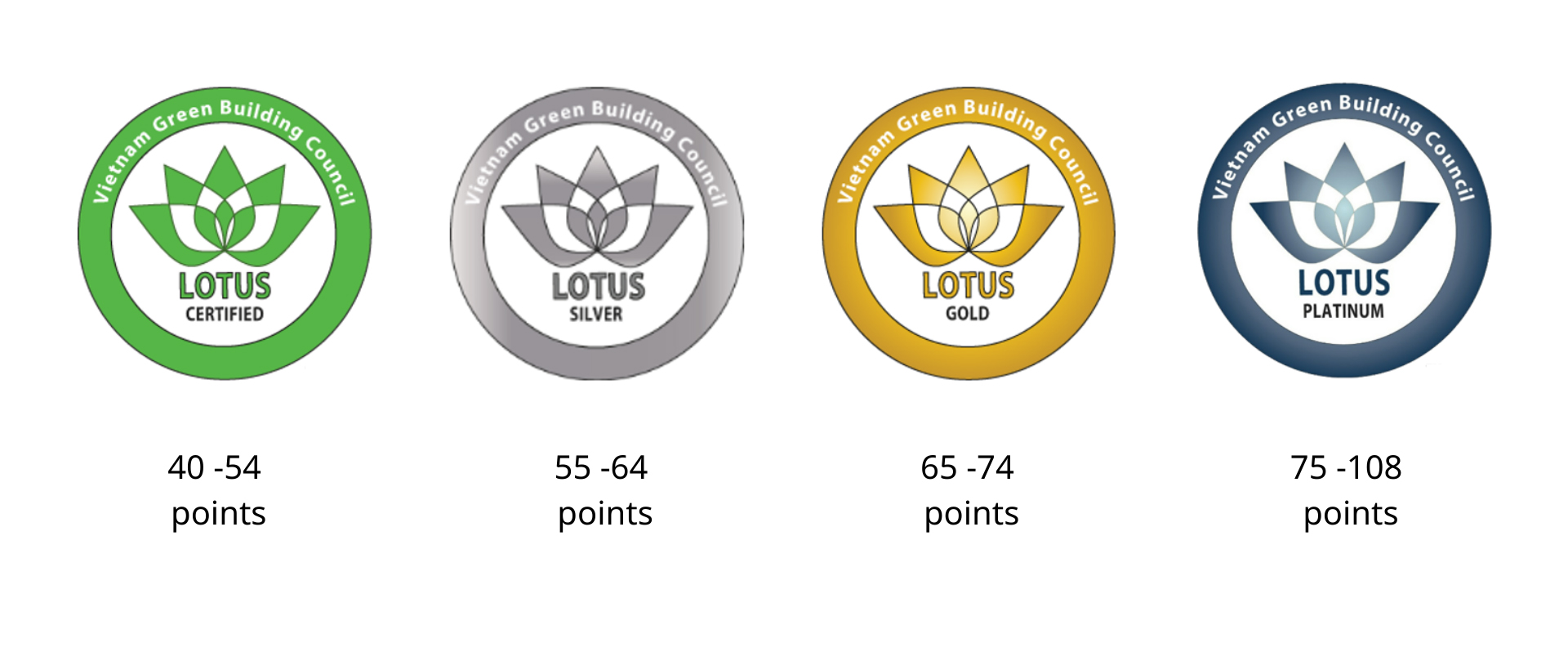
As we can see, as the ranking level increases, the standard requirements become stricter, compelling businesses to adhere more rigorously to the evaluation principles. Therefore, depending on their needs or the project model, businesses can improve their performance to achieve the desired ranking level.
LOTUS Evaluation Criteria System
In the latest update, LOTUS has established seven criteria for the design, construction, and operation of buildings. These seven criteria are further divided into two subgroups:
- Mandatory criteria: energy, water, materials & resources, health & comfort, location & ecology, management.
- Voluntary criteria: Superior Performance.
Energy (32 points)
This criterion is designed to encourage businesses to use energy efficiently and conservatively, and, where possible, to switch to natural or renewable energy sources. Since energy directly impacts the environment, this can be considered one of the key requirements of LOTUS.
Water (13 points)
Construction projects, especially large-scale ones with extended construction periods, are often the cause behind the depletion of groundwater aquifers due to the excessive water required for the project. This inadvertently reduces water quality and risks depleting clean water sources. Therefore, businesses must ensure the efficient use of water throughout the construction process and for the long-term operational phase.
Materials & Resources (12 points)
Instead of materials like concrete or waste materials requiring incineration, LOTUS encourages businesses to choose sustainable, recyclable, and reusable materials. Not only do sustainable materials and resources help protect the environment from waste during construction and greenhouse gas emissions from incineration, but they also help businesses save on operational costs by allowing for repeated use for various purposes.
Health & Comfort (14 points)
As the name suggests, this criterion emphasizes improving the indoor environment to ensure comfort and safety for occupants. LOTUS evaluates this criterion based on requirements related to air quality, thermal and acoustic systems, ventilation systems, etc. To enhance work performance while positively impacting users’ health and well-being, LOTUS also encourages businesses to design an open, airy space that maximizes natural light.
Location & Ecology (21 points)
The building must feature a landscape design suitable for local conditions and climate change. Most importantly, the selected site should be near areas with public transportation networks to promote sustainable transportation over private vehicles. Additionally, businesses must ensure they minimize negative impacts on the surrounding ecosystem.
Management (8 points)
To optimize operational efficiency while reducing costs, LOTUS offers integrated design solutions, encouraging businesses to use BIM applications in building operations or similar smart management measures.
Superior Performance (8 points)
This is the only criterion in the voluntary section of LOTUS, serving as an additional reward for outstanding businesses. To earn these bonus points, businesses may:
- Implement advanced solutions to improve building performance beyond LOTUS’s required standards.
- Apply new ideas, initiatives, or technologies not covered by LOTUS.
Conclusion
With a clear and transparent evaluation system, LOTUS has laid the foundation for sustainable development of green buildings in Vietnam. And beyond being a standard evaluation system, LOTUS serves as a guiding compass, leading us ever closer to a sustainable world.